

I have been away from posting for months now. I kinda missed it, but I was diverted to other things.
Ok, that was actually written almost a year ago… and I never finished that post. 2024 was a rough year. I started to question what is important as result.
I started writing an other post last year that began with, “we are branching from the 20th century into the 21st. “
There was a major transition that occurred in the 20th century that those of us who arrived in the middle of that century might not have recognized.
One might argue that throughout pre-20th century history, major changes have occurred that impacted large populations. Several come to mind; the discovery of the wheel, the utility of fire, the number zero, the printing press, calculus, the steam engine, … They all had major impacts on large populations. But for each, they surfaced far apart in time and took a relatively long time to become pervasive.
As we leave the 20th century behind us, consider what you have seen change during your life. Not one discovery, but dozens of major discoveries, all surfacing during a single lifetime. And each of these impact virtually everyone in the world to some extent. Just consider how you communicate and how you get information ( or how I am communicating with you right now). It is not only the rate of change and the rate of change to those things that changed, but also, the extent to which it has impacted billions of people. (Cell phones that became affordable less than 30 years ago are a good example. There are 74 countries in the world with higher per capita cell phone usage than in the USA. And there are only 195 countries.).
It IS kind of overwhelming to consider.
There are many topics that could be considered to demonstrate the extent of this revolutionary change, but I will leave those topics for another time (or someone else’s posts) and continue to focus on ENERGY.
Some background - My energy history
As I described in an earlier post, our first home solar installation was in 2006. It was modest in size by today’s standards; just 2.5kW. We did not pair it with batteries. Storage at that time both required extremely high cost and maintenance effort. So we decided that storage was not going to be part of our system.
Along with this solar, we got to leverage features of PG&E’s E9 tariff. This tariff was simple. It was our first time-of-use tariff replacing the tiered tariff that was customary at the time for most homes. It had a special (and simplistic) incentive feature. When we produced energy from our solar array, the meter would simply run backwards. And the meter was interesting. It was designed specifically for that tariff. In the summer, the day rate was 32 cents per kWh and after midnight it was just about 5 cents per kWh. The meter recorded the NET usage for each period and the meter reader came by monthly to record the various period values.
With this E9 tariff and as early EV drivers, we charged the car after midnight. We even scheduled our clothes drying to take advantage of the low nightly rates. The modest array collected energy and either supplemented our usage or sent it back to the utility. As a result, at the end of the first year, we not only reduced our electric bill - we actually didn’t have to pay anything. Though we consumed more energy than our little array produced, we were selling energy to the utility at $0.32/kWh and buying it for much less. Each August PG&E sent us a check for something like $80. They owed us!!!
I have to admit, as a business person I saw this as NOT a very sustainable business model. Here I was, the customer, getting a service from PG&E (reliable power and energy whenever I needed it), and they were paying me for the privilege of doing that! If I thought about it, it was even worse! They were now providing a brand new service to me. Because I had no batteries, they were storing my energy for me. That saved me both cost and bother.
At the time, I thought to leverage this unfairness to my advantage and attempted with some friends to launch a company (Scalablepower) to provide neighborhood energy systems where people could subscribe and own portions of offsite power solar systems. The startup never launched, but that’s when I began my journey in learning more about the grid and the power system we all enjoy.
Electricity? We get it delivered to our homes…
Contrary to many of my fellow utility customers, I have great empathy for the challenges our public utilities face.
When I began this post (a year ago) I characterized a shift from the 20th to the 21st century with a particular focus:
We moved rapidly from an energy light world into an energy heavy world.
My grandmother’s 1915 neighborhood home was initially built no electric connection. Electricity was a luxury. 30 years later it was common to have electricity to provide light and a few other conveniences. But today can you imagine your life without electricity? It powers much of our homes and even more of our businesses and factories. Without it much of our daily routine crumbles.
I have attended a number of forums where there are discussions regarding reductions in renewable energy incentives. Rapidly the group discussion degrades into complaints about how the greedy public utility is just trying to increase profits. Okay, some of that might be correct, but I think we need to recognize the challenges those utilities are facing as our electric grid transitions to address 21st century realities.
My posts thus far have focused on energy; how we use it, where it does come from, and where it should come from. But in a recent neighborhood meeting I realized that very few of us actually recognize how complicated and (quite frankly) fragile is the energy world we live in. AFter talking with my neighbors, I felt I would focus this post on the basics, as I understand them, of how that electricity reaches us.
(I am careful to NOT say these are the facts about the grid,
but rather my thoughts about it, simply because I still am no expert on the topic.
Maybe just a bit more informed than the average utility customer.)
Our local utility’s published uptime target is 99.999%. I like numbers - how much time does that say they expect that its customers might be without electricity in a year. It comes out to 5 minutes and 15 seconds. I find that quite a high performance goal.
Most of us don’t recognize it, but for utility electricity to be usable it needs satisfy a number of concurrent metrics. It needs to be at a particular frequency (here in the USA that is 60 cycle/second), with a specific voltage (your wall outlet is 120 volts), of sufficient power (we will get to that later), while coming from multiple sources (there are many power plants that feed the grid.)
Our homes receive alternating current (AC) energy. Basically it means the electricity moves back and forth instead of just in one direction. (Easy to understand how that works if you consider that you expend just as much energy running 5 miles in a straight direction versus running 5 miles back and forth in a gym.)
With my handy-dandy graphing calculator I produced this diagram of what our power/energy wave (Voltage on the vertical axis) looks like over time (the horizontal axis.) It shows what voltage change occurs in your outlet during 1/60 of a second. The electricity swings in one direction and then smoothly reverses itself.
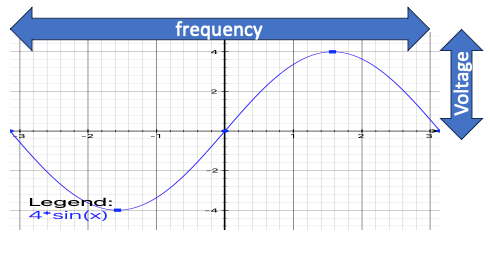
Our electrical and electronic devices rely on this electricity to be carefully conditioned. Too small a voltage (the graph flattening out), results in brown outs and our equipment stops working. (Kinda like pulling the plug out of the wall.) Too large a voltage (where those wavy lines get taller) and our equipment can be damaged. (Think what might happen if a lightning bolt hit wires connected to your computer.)
But to be honest, it is much more complicated than that. The energy we use relies both on the voltage (I think of this as the level or speed) and the current (I think of this as the number of electrons moving) of the electricity being delivered. Most people (including me) use the water analogy. Voltage corresponds to how fast the water moves and current is how much water is moving.
[This analogy failed for some folks until I tried the brick and pea analogy.
If I drop a brick from 10 feet up vs from 1/2 inch up - this is like voltage.
If you replace the brick with a pea, I think of this as a change in current. ]
We POWER our appliances. Both the current and the voltage levels determine how much power we get. There is a simple formula that describes this:
POWER = VOLTAGE X CURRENT
In most texts you will actually see this as:
P = V*A
Current is measured in Amperes, hence the “A”. And like Voltage, the current also varies over time. (Other equations use “I” to designate current.)
Back to the pea and brick example.
It is the combination of how high you drop the object
and the size of the object
that determines the impact you feel.
This corresponds to the POWER of the impact.
So imagine as Voltage swings to its maximum on the curve that Current is zero at that point. That would result in Power ending up being zero. In that case your appliance simply won’t run. So the first challenge after making sure the Voltage and Frequency are correct is to ensure the Current is synchronized with the Voltage in order to result in positive power.
The very first electric “grids” were pretty small and only had a single power plant. Once the utilities began growing, grids required multiple power plants, and utilities had another challenge. All of the plants would need to produce their power in step with each other, ensuring they were adding power to the grid at the same frequency and voltage. If they did not the resulting wave form would change and be somewhat bumpy.
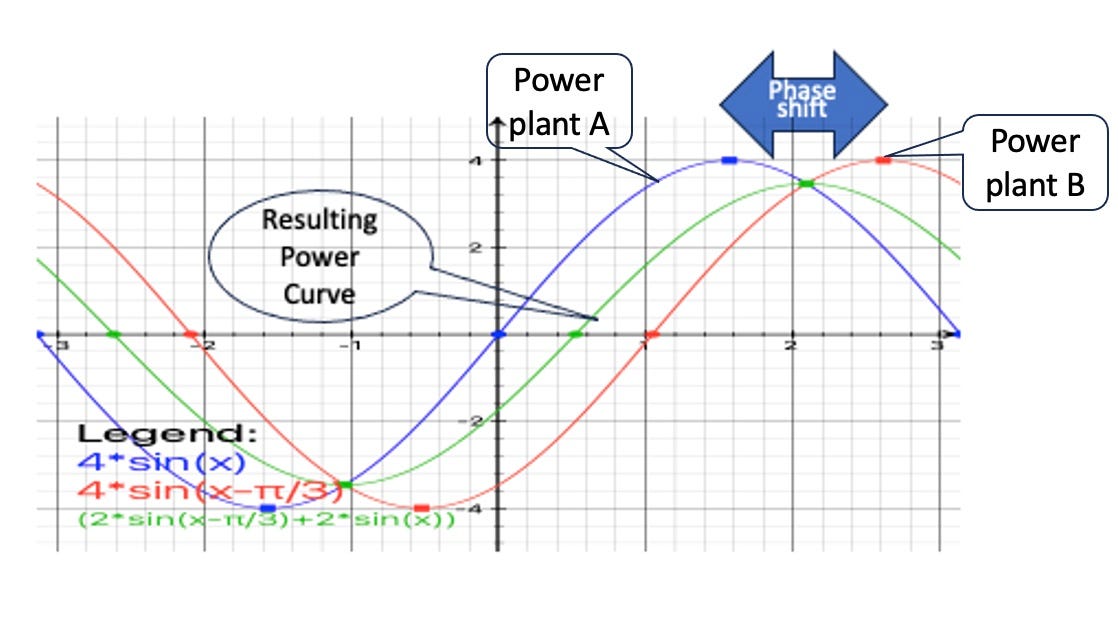
But even if they did achieve the same frequency and voltage, using simple electrical circuits, they must still ensure they continue to run in phase; that is the zero voltage time and peak voltage times must be synchronized.
Here is a diagram demonstrating what happens when two plants (the red and blue lines) didn’t end up in Phase. Notice how it results in decreasing the grid voltage (green line). That green line would cause a brown-out.
So you can guess, with multiple power sources on an interconnected grid starting in 1921 and throughout the 20th century, that utilities had a complicated problem to solve. However, with complete visibility over the sources of power and delivery, it was possible to put the controls in place to ensure all the power sources feeding the grid complemented each other.
However, they still were challenged as they had virtually no control over the demand. DEMAND is us consuming the power.
The matching Demand Problem
I have to confess, that originally I never considered how the grid functions. I was thinking they produce the electricity and it is there for me to use. But I didn’t consider MY ROLE in the stability of the grid. As I turn on my appliances, I consume some of that power.
Here that water analogy starts to work again. Imagine that my power use corresponds to me pumping some water out of a river that is flowing past me. Well that means there is less water for the folks downstream. If enough of us do that at the same time, then the stream will start to lower and eventually dry up.
And that is exactly what happens on the grid!. As we use the power on the grid to run our appliances, the grid power starts to drop (brown-outs). If the utility responds by pumping more energy out, but we all suddenly stop using power… flooding… The voltage on the grid climbs above that 120V.
In fact that brings us to the next grid complication.
              AT ANY INSTANT IN TIME, THE SUPPLY ON THE GRID
                  MUST MATCH THAT INSTANTANEOUS DEMAND
Throughout the 20th century, pretty much the utility had complete control over the supply either through its own facilities or through the agreements they have with power providers. (In California public utilities can only own nuclear and large hydro energy plant. All other power they are required to source from 3rd parties.) So you can imagine what a challenge it is to increase or decrease power on the grid to match precisely a fluctuating demand that you have no control over.
Luckily with millions of us, statistically the hourly demand could be somewhat accurately projected. Heat waves and sudden failures in supply could still cause unexpected excursions. But the utility does a pretty good job of keeping the balance and achieving their uptime goals.
It is quite a balancing act that is supported by studying historical use patterns. But now we move from the 20th century realities to the 21st century expectations.
So let’s throw some more variables into the mix and see what happens.
Renewable energy causes problems
Perhaps you can already guess why I say Renewable energy causes problems from the hints I gave above. Utilities pretty much had control over the electricity supply and they depended on predictability of demand patterns to provide the reliable, high quality power and energy we have come to expect from them. The 21st century is going to not only introduce a change in demand intensity, but because we are introducing renewables quickly as a Distributed Resource Energy (DRE), the supply-side controls and reliability are being compromised.
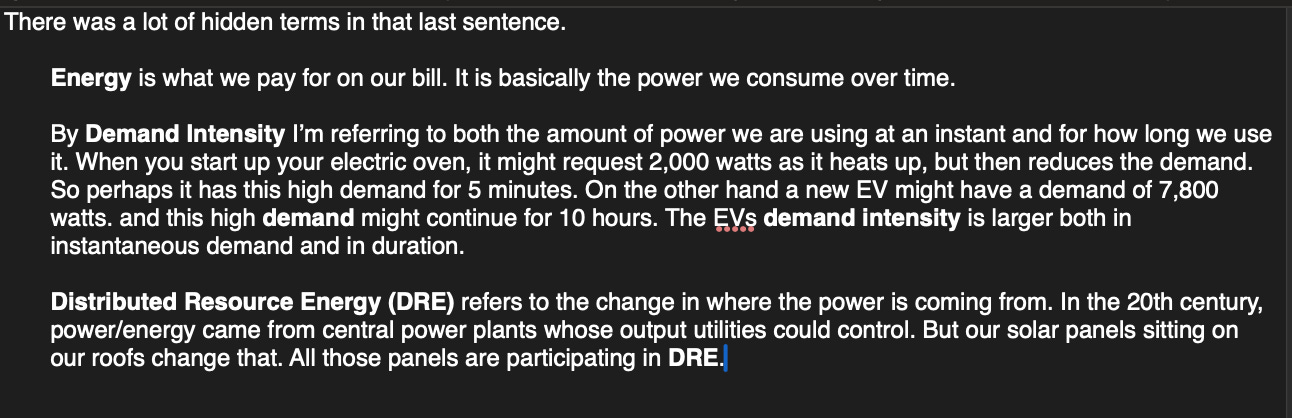
The nexus of Distributed Resource Energy and Renewable Energy is the supply challenge posed in the 21st century.
With DRE, the utility no longer has control of the supply. In fact, it has little visibility of when the energy comes online or drops off. And the source of Renewable Energy, even if they were centralized, are uncontrolled. The sun shines at specific hours, but the clouds control its intensity. Weather impacts both solar and wind supply. And unlike when one power plant has an interruption, when a neighborhood suddenly is darkened by a storm front, every home’s solar system will curtail production of electricity.
What's the big deal?
So hopefully I left you with an appreciation of how challenging it is to deliver reliable, high quality electric power to us. We take it for granted, but indeed it is a technological marvel.
In this post, I describe how DRE and Renewables will force a change in the way we achieve continuing to have a stable grid. In a previous post (Electrify Everything) I covered my experience that demonstrates how peaks will shift as electric vehicles become the norm. This shift in intensity too will play a large role in determining what grid changes are necessary.
21st century solutions for 21st century challenges
We assume the way things worked in the past is how they will work going forward. But moving from the 20th century needs and constraints into the 21st century needs and opportunities cranks up the degree of difficulty of continuing to accomplish maintaining that 99.999% uptime mark. Changes are already occurring that require fundamental reconsideration of how the grid will need to function.
And that leads us to the target of my next post, The Grid. And more specifically my thoughts about the distribution grid, the 21st century pressures on it, and how it is likely to transform over the next decade.