

In my previous post, I left you with the question not asked,
“How will we address the new distribution grid challenges without having to incur the cost of replacing those grid resources.”
I had expected to quickly answer that question, but as I thought more about it I considered it deserved a deeper answer than I was prepared to post at the time and questioned whether what I propose has legs. So, I am hoping as you read and review this you might offer your opinion and ideas.
How did I get interested in this?
In 2023 friends and I created a small team to respond to a solicitation by our local utility, Northern California’s PG&E. As I mentioned in previous posts, the utility posed a number of problems during their July 2023 Innovation Summit. They asked attendees to offer solutions to each of 70 problem statements that they organized into 6 general categories.
We decided to respond with a solution that we felt addressed a number of the problem statements in three of those categories; Supply and Load Management, Integrated Grid Planning, and Electric Vehicles. Our focus was in restructuring the existing grid assets in such a way that it could more easily accept Distributed Energy Resources (DER). In doing the research, we tripped over a new term to us, DERM, Distributed Resource Energy Management.
I don’t want to argue here that our specific solution was THE right one. (If you want to see our pitch, you can find our Smart-Stor solution posted on scalablepower.net.) However, our specific solution relied on a general direction that I believe to be the most productive approach. It might be summarized by this:
Public utilities should broaden their product portfolio and
provide onsite, in-front-of-the-meter energy storage.
That’s a very short statement and it doesn’t cover the depth of what it means. But it does suggest that as DERM replaces our model that relies on centralized energy supply, that the utilities themselves become the primary DERM provider.
Utilities are actively adjusting
Curiously, California’s utilities have been following parallel paths. Many of the new power contracts that utilities execute call for Virtual Power Plants (VPPs). One form of VPP is done using home solar and battery installations. The power provider signs a contract with building owners when they install the system. Once the system is live, the supplier retains the right and ability to either curtail utility power or to discharge the battery storage to the grid for a certain number of hours per year at a limited power level (kW level). When the utility conveys to the contract holder that the grid needs support, a signal is sent to a number of building systems that triggers them to perform. In this regard the VPP very much provides the same function as natural gas peaker plants operating today, but instead of being in a single location, the VPP power may come from hundreds of building installations.
The other method of leveraging DERM which utilities are just initiating is by tapping the energy in Electric Vehicle batteries. In this case, they are financially supporting installation of Vehicle to Grid (V2G) charging stations in hopes that in the future they will be able control both the charging and discharging of these large EV battery systems on demand.
In both of these cases, the strategy is to replace the existing need for peaker plants power and to affect simple demand moderation.
Utilities are also attempting to minimize the impact on the grid of those uncontrolled behind-the-meter sources of power (in the form of solar arrays) have on the grid. By using tariffs as negative incentives, the hope is that the impact of these systems can be isolated from the grid by promoting new systems to always include storage in their design.
If you look closely at what features that utility-supplied distributed energy-storage could include, it becomes obvious why a solution that integrates tightly with the utility’s distribution grid and the utility’s mission would be a superior approach.
Why are we suddenly talking about this?
Over the past 30 years we have developed cost-effective methods of producing electricity near the consumer. It comes as no surprise that capture of solar energy and converting it to electricity is the primary method of doing this. (And solar energy after all, with the exception of nuclear and geothermal, is ultimately the source of all the other forms of energy that we tap.) The dramatic drop in cost of solar is making this a compelling solution.
The typical solar panel cost in 1990 was 10 dollars/watt. Today that typical cost is 10 cents/watt. Adjusting that value for inflation, there has been 250 fold reduction in panel cost over a 35-year period. With the typical system lifetime of 25 years, installed in my climate zone in Northern California, that results in a delivered cost around 13 cents/kWh. If I review rates around the country, the lowest delivered utility provided energy averages 12.7 cents/kWh and the highest is 52 cents/kWh.
If you are stumbling over kW, watt, and kWh.
kW and watt are how fast you get energy.
kWh is how much energy you get
It is often hard to understand these costs when we learn that wholesale electric energy cost can be as low as 4 cents/kWh. It seems like quite an unreasonable markup! That’s where we start to understand the impact of the cost of delivering the energy to our homes. The benefit of distributed energy resources is the delivery cost is already included since ideally it would never use the distribution grid.
I went down this rabbit hole just to explain that the real reason for considering Distributed Energy Resources is cost reduction. But at the same time the real problem with distributed energy is the lack of control. It is that control of supply which has guaranteed us the 99.999% uptime we take for granted.
One might argue that we should centralize the generation and still rely on these more efficient and lower climate-impacting direct solar sources. Why? We are finding ways to reduce the losses from transforming primary energy resources into usable electric energy, but we have not found ways to reduce and simplify delivery to the ultimate consumer.
Implementation of Distributed Energy Resources can deliver more than simple cost reduction. It can simplify and balance the grid without requiring that the existing transmission and distribution grid be renovated. However, in order to do that predictably, positive control that balances supply and demand is required.
It is time to think differently (or as André Schwager would say, think orthogonally).
Centralized Control
In an earlier post, I explained why I believe the utility requires such extensive review of the solar and storage systems we install on our buildings. It has to do with ensuring the controls are in place so that the electric energy shape and stability is not compromised; and that the wires and transformers in the neighborhood that comprise the distribution grid are sized for these changing demands. After all the utility has given up the one thing that gave them a chance of providing reliable power; control over the supply.
Recent tariffs here in California that support solar installations are under NEM3. This series of tariffs pay very little for feed-in energy (the surplus our home solar systems send back to the grid when we cannot consume it all at a particular instant in time.) The rationale (I believe) for this tariff change was NOT to slow down the rate of new solar system installations. Rather it was to incentivize new installations to always include storage in the system. Basically, the utility and the California Public Utility Commission are attempting to employ tariffs to restore control over the supply. I think this is not the most successful approach for a number of reasons.
The first of these is Control. Historically, the utilities could send signals to plants to increase supply on demand. For gas-powered peaker plants bringing this power online could occur in as little as 5 minutes. Contrast this to a solar system. How does the utility tell the sun to move to a good position or make the clouds evaporate?
You could take this and use it as an argument against relying on solar at all. And I would agree. As I discovered with my first experience installing a solar system, a solar array without a storage system to handle the timing of the delivery of the power is a losing proposition. But even with storage, if the system is designed and configured to support the goals of the system owner, it cannot be relied upon to support the instantaneous needs of the distribution grid.
The second reason the solutions are being employed today to support DERM is Scope. As I am writing that sentence, I am challenged to explain why I think this is significant and indeed what I mean.
Today a fairly limited number of households in PG&E territory (our local utility) have solar and storage installed. The PG&E contract with Sunrun for VPP covers 8500 homes and offers 34 MW of power. In that same territory it is estimated that there is between 2200 and 4400 MWh of storage. That 34 MW is quite a bit smaller than the smallest gas peaker plants which offer 50 MW on demand.
But there are 5,000,000 households in the PG&E territory. If the scope of the solution extended to all those households as part of the utility offering, the utility would have up to 20,000MW of power it could call up.
Scope makes a difference when you are relying on a primary energy resource that itself can’t be controlled.
The Solution
The onsite utility energy storage should be able to actively participate in balancing the distribution grid. To do this, the proposal we sent to PG&E suggested the utility should have the ability to directly increase demand when a distribution branch is experiencing excess power; and increase supply and decrease demand when that distribution branch power is sagging.
Distribution of Supply paired with Fine-Grained Control
By having controls throughout the distribution network, fine-grained control of power on the line at any point in any neighborhood could be instantaneously maintained. Even during a grid outage, the neighborhood could be assured that power would continue to be available.
The key is to eliminate peaks in both demand and now in supply. Intelligent storage systems that are filled both from the grid and from local solar can be used to maintain that neighborhood grid. This would be provided in the in the form of a device installed by the utility in front of each customer’s meter. Key is how the device functions.
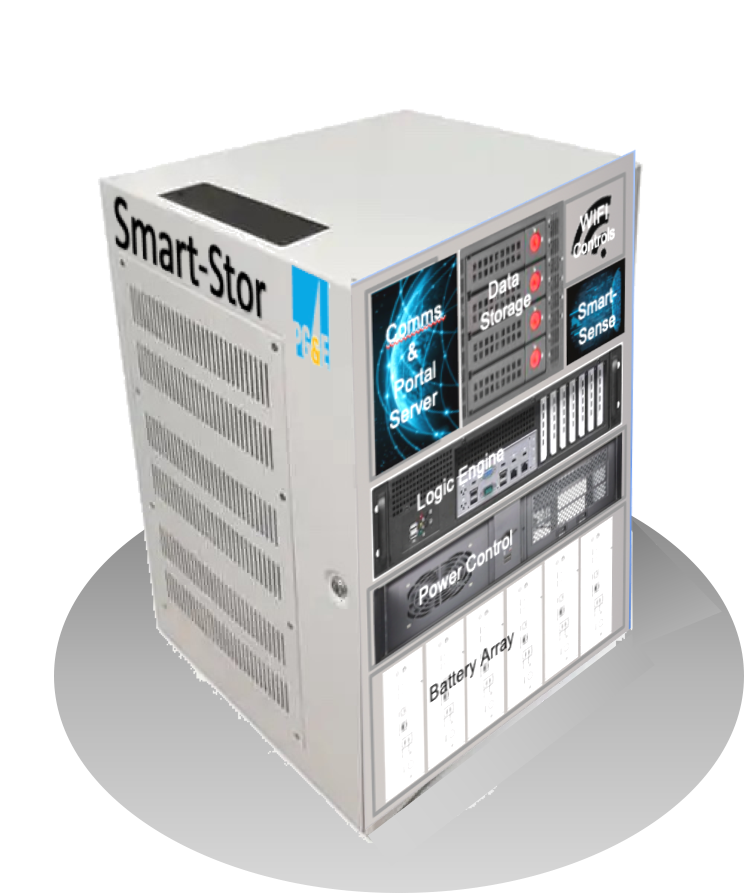
The device would function based on GOALS. These could be in the form of voltage levels to be maintained, energy capacity buffers, and constraints on how much management is permitted. And the device would need to provide value to both the utility and to the customer.
It is obvious what some of the components of this system might need. Certainly, storage is the primary component. But as any family living with a behind-the-meter battery storage today learns, it is not just having the energy when the grid goes down. The battery is used whenever you have demand in the building in order to reduce what is needed from the grid. And the battery has to have headroom (space) to storage energy when the home is using little and the solar panel are generating surplus. Again, this is to reduce the amount of energy flowing onto the grid. But the battery, as utility resource could also be used when your neighbor has too much or too little energy available.
With that last example, you might recognize the other dimension of SCOPE that the utility controlled storage satisfies. A neighborhood solution starts to evolve and replace the single home solution.
There are other components the system needs. There is a power module. This ensures the power is delivered at the right time, has the right frequency, and is in phase with what the grid expresses.
A logic engine is in place to determine the best way the device can function to satisfy the grid and home power and energy goals. This needs to be pretty intelligent as it considers weather patterns, solar performance over time, and the household’s typical demand pattern. Completing much of this analysis would require recording and storing past patterns, so a place to store that data and insuring it is secure on the property is required
A full system could be paired with a wifi connection that might control high sustained demand. With the transition to Electric Vehicles, which typically get refueled at home, it will be necessary at times to limit the number of vehicles drawing power in the neighborhood at one time. Either signals to devices or now emerging wifi-controlled circuit breakers make this level of control easy to install.
And finally, communication that allows the utility to both monitor the system, send software updates, and to periodically when needed modify the goals the devices follow in a neighborhood
Summary and Soapbox
I recognize that I am a bit locked onto a typical solution. There is a lot of sentiment against our monopoly utilities and assumptions of their motives (profit). But I question if the behavior they express is strictly driven by profit. I believe most of the tariffs and business direction is in driven by a need to get CONTROL. And the rationale for that is not to increase profits so much as it is to provide a reliable service.
When I describe this DERM solution, most people object to it because I suggest the utility should be the one to implement it. Admittedly, it is an expansion of their business. But for me it is an expansion that would benefit each of its customers, those with solar, and those that don’t have it.
A neighborhood solution….